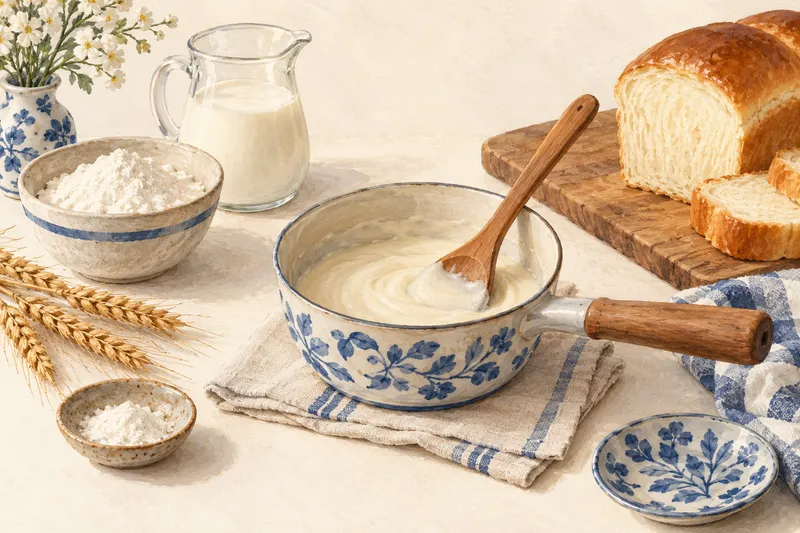
Both begin before the main dough
Tangzhong cooks a portion of flour and liquid together into a paste. Yudane commonly pours boiling water over flour. King Arthur explains that both gelatinize starch and help retain moisture, but their preparation is different.
Its comparison gives typical flour-to-liquid ratios of 1:5 for tangzhong and 1:1 for yudane, by weight. These are descriptions of common methods, not universal conversion instructions.
Keep the ingredients inside the total
If a recipe assigns 25 g flour and 125 g liquid to a tangzhong, those amounts belong to its overall formula. Do not add them again to the final dough unless the recipe explicitly lists additional quantities.
Write two columns: paste ingredients and remaining dough ingredients. Add them to check the total before mixing. The baker’s-percentage tool can help express ingredient amounts relative to total flour.
Follow a developed method first
Read the paste endpoint, cooling instructions, mixing sequence, and fermentation cues. A dough made with a scald can feel different from an unscalded dough at the same numerical hydration.
What the method is for
It is especially associated with soft loaves and rolls. It is not an automatic improvement for every crisp or chewy bread style. Decide whether lasting softness is the intended result before adapting a formula.
Make a useful comparison
Keep loaf size, flour, and storage conditions consistent. Compare the cooled crumb and next-day eating texture. Moisture retention is a quality observation, not proof that a bread or its filling has a longer safe storage life.
Sources & scope
Reference synthesis and arithmetic where indicated. No first-hand kitchen testing is claimed.
- A closer look at tangzhongKing Arthur Baking · Accessed 2026-10-06