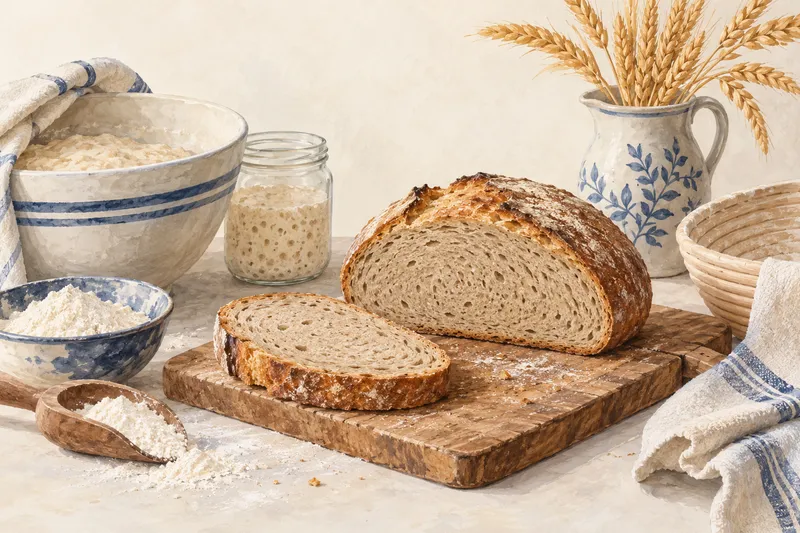
Open crumb is a choice; weak fermentation is a problem
A close, even crumb can be desirable for sandwiches. Diagnose a loaf that failed its intended result rather than treating every small hole as a fault. Let the bread cool before judging a sticky or compressed center.
Keep starter and dough observations separate
A starter that rises in its jar is one observation. A mixed dough that expands during bulk fermentation is another. Record feeding time, starter condition when mixed, dough temperature, and bulk start/end times. Do not infer adequate dough fermentation solely from bubbles in the starter.
A complete formula provides useful checkpoints
King Arthur’s Naturally Leavened Sourdough Bread uses 454g ripe starter, 600g all-purpose or the specified bread flour, 85g whole-wheat flour, and 397g water. It includes a 20-minute initial rest, kneading, and a fold between two one-hour rising periods before division and shaping. Use the complete recipe for the remaining proof and bake instructions.
These are checkpoints within that formula, not a universal two-hour bulk-fermentation promise. A different dough temperature, starter condition, or recipe needs its own schedule and cues.
Calculate hydration before blaming the water
If the 454g starter in that example is 100% hydration by weight, it contributes 227g flour and 227g water. Total flour is 600 + 85 + 227 = 912g; total water is 397 + 227 = 624g. Hydration is 624 ÷ 912 × 100 = 68.4%.
Using only 397 ÷ 685 would miss the starter and give 58.0%. The calculation’s starter-hydration assumption must be checked; a stiff or liquid starter changes the result. Use the sourdough hydration tool with your actual feed ratio.
Investigate the first stage that went wrong
Scroll the table sideways if needed.
| Observation | Check next | Avoid |
|---|---|---|
| Starter was used before its recipe’s ripe stage | Feed record and observed rise | Increasing dough water to compensate for an unverified starter |
| Bulk dough barely changed | Actual dough temperature, elapsed time and starter condition | Shaping solely because the clock says so |
| Dough expanded, then weakened or deflated | Bulk and final-proof records, handling and flour | Assuming every dense loaf was underproofed |
| Dough rose but the cooled loaf has a gummy center | Bake endpoint, loaf size and cooling | Treating large holes or dark crust as proof of a finished center |
King Arthur’s open-crumb discussion addresses flour, hydration, fermentation, and handling together. Increasing hydration alone is not an established cure for dense bread. Correct the earliest measured deviation and keep the other variables steady for the repeat.
Your next-batch checklist
Use this while reviewing the recipe. Selections stay on this page only.
Sources & scope
Reference synthesis and arithmetic where indicated. No first-hand kitchen testing is claimed.
- How to produce an open crumbKing Arthur Baking · Accessed 2026-10-06
- How to tell if bread is doneKing Arthur Baking · Accessed 2026-10-06
- Naturally leavened sourdough breadKing Arthur Baking · Accessed 2026-10-06