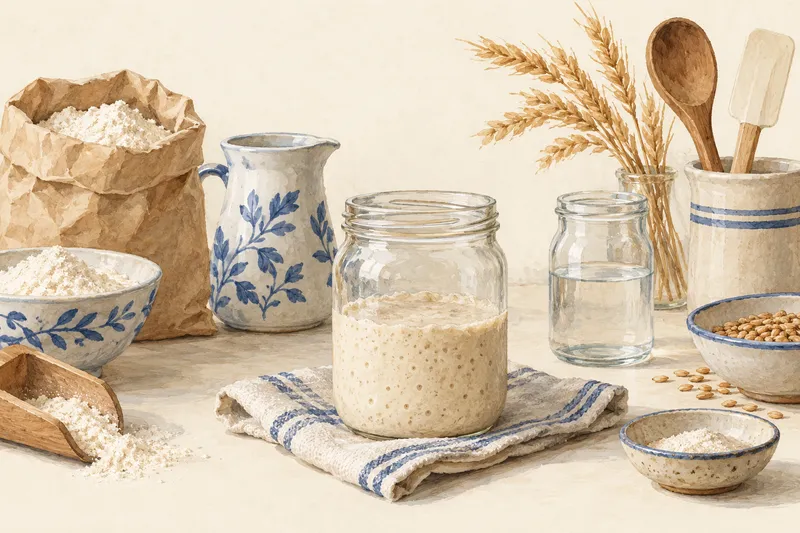
Bubbles alone are not a baking schedule
A new culture and a mature starter recovering from refrigeration need different expectations. Start by identifying which you have. King Arthur’s starter guidance uses regular feeding and observation; the calendar alone does not establish readiness.
Build a useful observation record
Mark the level immediately after feeding in a straight-sided container. Record starter, flour, and water weights; flour type; room temperature; and the times you check it. Leave room for expansion and follow safe covering practices.
A starter may have risen and fallen between observations. A residue line above the current level is worth recording. Repeatedly looking only at one time of day can miss that pattern.
Check the feeding calculation
Ratios are by weight. At 1:2:2, 20 g retained starter receives 40 g flour and 40 g water. This arithmetic describes the feed; it does not predict the hour of peak activity. Use the starter-feeding calculator to scale a chosen ratio without guessing cup volumes.
Recovering a neglected starter
First distinguish a previously active refrigerated culture from a brand-new starter. A dormant established starter may respond to feeding; visible mold, pink or orange discoloration, or a putrid smell belongs on the discard pathway. If growth or history is uncertain, do not scrape it off and infer that the remainder is safe.
For an uncontaminated established refrigerated starter, King Arthur’s named recovery method retains 50 g starter, adds 50 g flour and 50 g water, and observes it for 12 hours in a loosely covered, straight-sided jar at about 75–78°F. Repeat the measured discard-and-feed cycle as instructed; do not keep adding flour to the entire growing jar.
That example separates recovery from bread readiness: renewed bubbles show activity, while a starter-only loaf needs the bread recipe’s ripe-starter criteria. King Arthur uses doubling within roughly 6–8 hours after feeding for the latter. These are conditions in its procedure, not a universal revival deadline, safety test, or rule for every stiff or liquid starter. Record successive rises rather than judging one photograph.
Before mixing bread
Look for repeatable activity under known conditions and follow the bread recipe’s definition of ripe starter. A recipe that depends entirely on starter has less margin for a sluggish culture than one also containing commercial yeast.
Use the starter feeding calculator to calculate a chosen feed by weight; it does not decide whether the culture is ready to feed.
Your next-batch checklist
Use this while reviewing the recipe. Selections stay on this page only.
Sources & scope
Reference synthesis and arithmetic where indicated. No first-hand kitchen testing is claimed.
- Create sourdough starterKing Arthur Baking · Accessed 2026-10-06
- Maintain sourdough starterKing Arthur Baking · Accessed 2026-10-06
- Do you think you killed your sourdough starter?King Arthur Baking · Accessed 2026-10-06