Start with the bread style
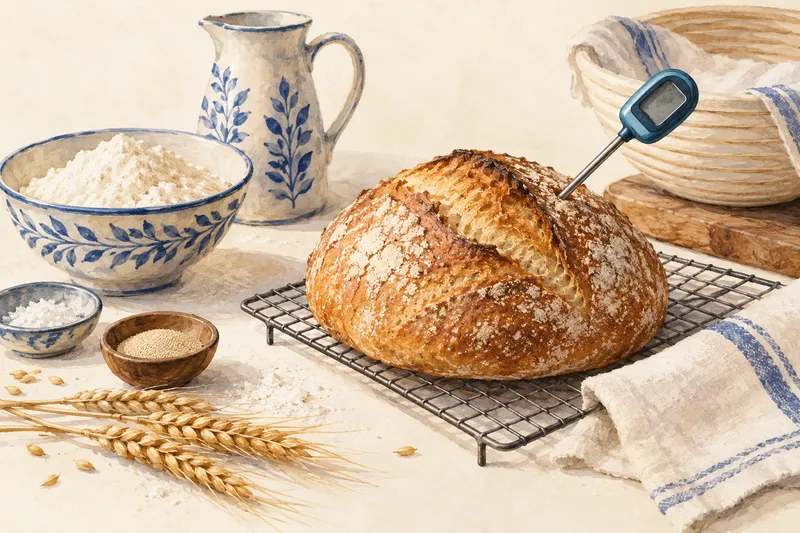
For ordinary wheat sandwich loaves, 190°F (about 88°C) at the center is a useful benchmark from King Arthur’s published baking comparisons. Its tested sandwich breads were softer at that endpoint than at 205°F. These were the publisher’s trials, not ours.
That benchmark does not cover every bread. Its baguette comparison depended more on a thoroughly browned crust; rye and gluten-free breads had different guidance. Keep your specific recipe’s endpoint when it supplies one, especially for filled loaves or unusual formulas. A number without the bread type is incomplete advice.
Before the loaf enters the oven
Read the complete baking and cooling instructions. Note whether the recipe expects a covered phase, an uncovered phase, a temperature change, or removal from the pan. A timer only has meaning alongside those stages.
Combine the checks
Appearance: compare the expected crust color, including sides where visible. A topping or wash can change browning.
Structure: use the recipe’s description of crust firmness and loaf shape. Handle hot bread with suitable protection.
Temperature: where a recipe specifies a center reading, probe the actual center rather than touching the pan or measuring just beneath the crust. A single off-center reading can be misleading.
Time: use the stated range as a checkpoint, not a guarantee. Changed loaf size, pan material, and oven behavior can alter it.
If the top browns too quickly
Consult the recipe’s shielding or temperature guidance. Covering the top does not establish that the center is finished. Continue checking the intended endpoint rather than removing the loaf solely to preserve its color.
Cooling belongs to the method
Follow instructions for removing the loaf from its pan and allowing it to cool before slicing. Record the cooled crumb, not only the hot loaf. If the interior is still gummy, review both baking and the time of cutting before changing the formula.
Sources & scope
Reference synthesis and arithmetic where indicated. No first-hand kitchen testing is claimed.
- How to tell if bread is doneKing Arthur Baking · Accessed 2026-10-06
- Using a thermometer with yeast breadKing Arthur Baking · Accessed 2026-10-06