Decide whether the crumb is wrong for that bread
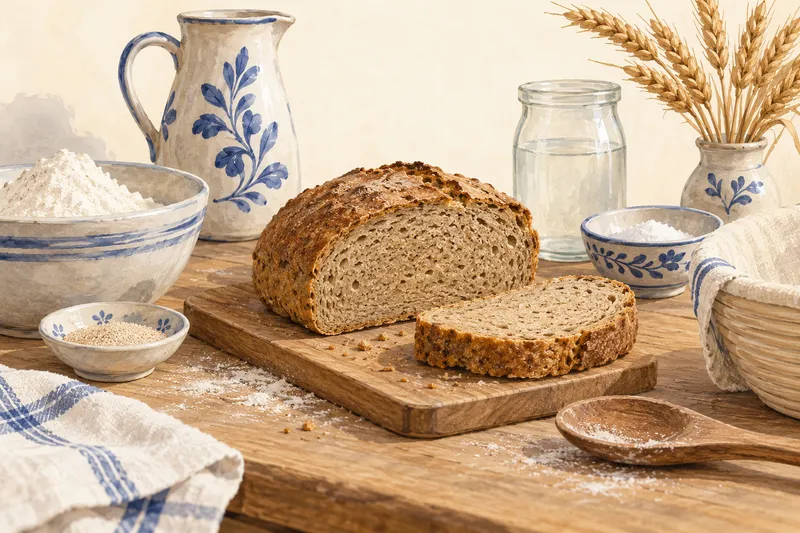
A sandwich loaf should not be judged by a highly open artisan crumb. Record whether the problem is limited rise, a stiff dough, a collapsed loaf, or a gummy center after cooling. Those observations point to different stages of the process.
A named loaf shows why rise cues matter
King Arthur’s Classic Sandwich Bread describes its first rise as puffy, not necessarily doubled. For its 8½×4½-inch pan, the final rise reaches about 1 inch above the rim, with a pressed mark rebounding slowly. Its center endpoint is 190°F, followed by rack cooling.
Those cues belong together in that recipe. “Double every dough” or “190°F finishes every bread” would discard the bread-style context. King Arthur’s doneness guidance discusses different endpoints for different breads.
Follow the stage that first departed from the recipe
Scroll the table sideways if needed.
| First problem observed | Check | Useful next action |
|---|---|---|
| Little expansion during the first rise | Yeast identity, dough temperature and actual elapsed time | Check fermentation conditions before changing the oven setting |
| Dough became much stiffer during kneading | Incorporated bench flour and original flour weight | Measure additions and restore the formula on the repeat |
| Shaped dough deflated before baking | Proofing history and handling | Compare the recipe’s proof cue with your recorded shape and rise |
| Center is gummy only when sliced warm | Bake endpoint and cooling time | Assess a fully cooled center before attributing the problem to yeast |
The publisher’s rising-dough guide can help investigate an inactive or slow first rise. A colder dough may need more time; warmth and time do not rescue an incorrect ingredient automatically.
Quantify a common hidden change
For an arithmetic example, 500g flour + 325g water is 65% hydration. Incorporating another 50g bench flour makes it 59.1%: 325 ÷ 550 × 100. That substantial change can be hidden behind an instruction to add flour “until it feels right.”
Use the baker’s percentage calculator to record the change, not to prescribe a hydration for every loaf. On the next batch, keep the recipe, flour, and pan fixed while correcting the earliest documented deviation.
Can an overproofed loaf be reshaped?
For a commercially yeasted dough, sometimes. King Arthur’s demonstrated recovery uses its Classic Sandwich Bread: reshape the oversized loaf, return it to the pan, and check the renewed rise early rather than repeating the original full proofing time. Its example sets a 20-minute check and bakes when the loaf reaches the stated pan-height cue.
The publisher limits that advice to suitable active-dry or instant yeast doughs; a rapid-rise product designed for one quick rise may not fit. It also says this technique generally does not work for sourdough after its longer fermentation. Do not transfer the example’s pan-height cue to croissants, free-form loaves, or every sandwich dough.
Record whether the dough was slow from the start, rose well and then collapsed, or became dense only after baking. That history helps distinguish missing fermentation from too much final proofing. Reshaping cannot fix a contaminated dough or erase unsafe handling of perishable ingredients.
Your next-batch checklist
Use this while reviewing the recipe. Selections stay on this page only.
Sources & scope
Reference synthesis and arithmetic where indicated. No first-hand kitchen testing is claimed.
- My dough is not risingKing Arthur Baking · Accessed 2026-10-06
- How to tell if bread is doneKing Arthur Baking · Accessed 2026-10-06
- Classic Sandwich BreadKing Arthur Baking · Accessed 2026-10-06
- Over-proofed bread dough: How to save your loafKing Arthur Baking · Accessed 2026-10-06