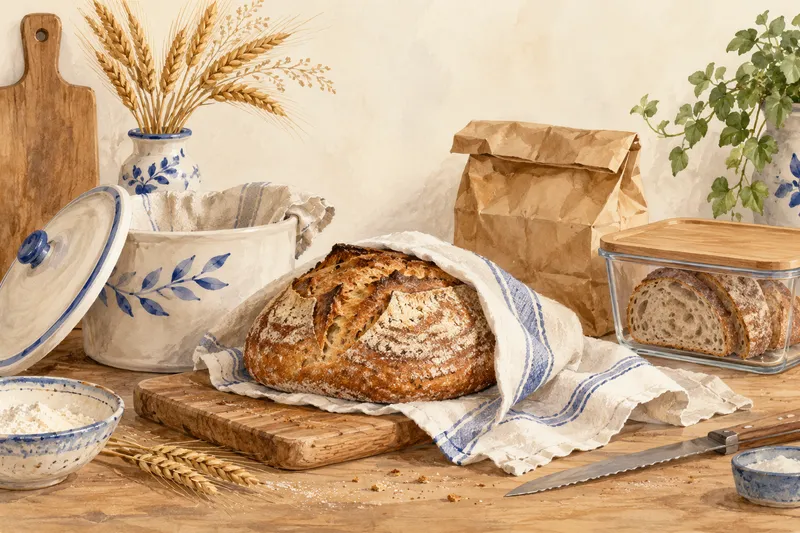
Start with the kind of loaf
This guide concerns a plain baked sourdough loaf. A bread containing perishable fillings or toppings needs the storage instructions for those ingredients. The word sourdough does not make every finished product suitable for counter storage.
Cool before packing
Follow the recipe’s cooling instructions before wrapping. Plan storage around when you expect to eat the loaf: a portion for near-term use and portions to freeze. Slicing before freezing can make it easier to remove only what you need.
Crust and convenience are a tradeoff
King Arthur’s naturally leavened loaf recipe suggests a paper bag or loose plastic covering for about a day at room temperature, then wrapping and freezing for longer storage. That is guidance for its particular loaf, not a guaranteed shelf life for every kitchen.
A container chosen to preserve a soft interior may not preserve a crisp crust equally well. Decide which texture matters for the next meal rather than assuming one wrapper is universally best.
Make the freezer portion usable
Pack portions securely in freezer-appropriate wrapping, label the date and loaf type, and keep them protected from crushing. Note whether slices are separated so they can be removed individually.
Follow the original recipe’s thawing or reheating guidance. Reheating is a texture step, not a way to make spoiled bread acceptable.
Keep a storage note
Record wrapping, room conditions, and how the crust and crumb change. This helps improve the next batch’s portion plan without inventing a fixed shelf-life promise. Discard bread with mold rather than cutting a visible spot away and treating the rest as safe.
Choose a bag for the texture you want
For a cooled plain loaf, plastic wrapping or an airtight bread bag retains moisture but softens a crisp crust. Paper or loose covering better preserves that crust for immediate use but offers less protection against drying. A food-storage zip bag is therefore a practical moisture-retention option, not a guarantee of a crisp crust or a fixed shelf life. Do not pack a steaming loaf or use this comparison for bread with perishable fillings.
Freeze plain bread in serving portions
King Arthur’s bread-freezing guide uses two airtight layers, such as plastic wrap inside a bread bag. Group slices into the quantity you normally serve, or separate them with parchment so one portion can be removed without thawing the loaf. Its general quality target for most breads is up to three months, not a safety deadline for every formulation.
For its plain-bread examples, the wrapped loaf thaws at room temperature for roughly three hours, rolls around an hour, and slices in under 30 minutes; size and room conditions change those estimates. Plain frozen slices can also go directly into a toaster. This room-temperature thawing example does not apply to cream-filled or other perishable filled breads.
Sources & scope
Reference synthesis and arithmetic where indicated. No first-hand kitchen testing is claimed.
- Naturally leavened sourdough breadKing Arthur Baking · Accessed 2026-10-06
- Molds on Food: Are They Dangerous?USDA FSIS · Accessed 2026-10-06
- How can I freeze my bread?King Arthur Baking · Accessed 2026-10-06