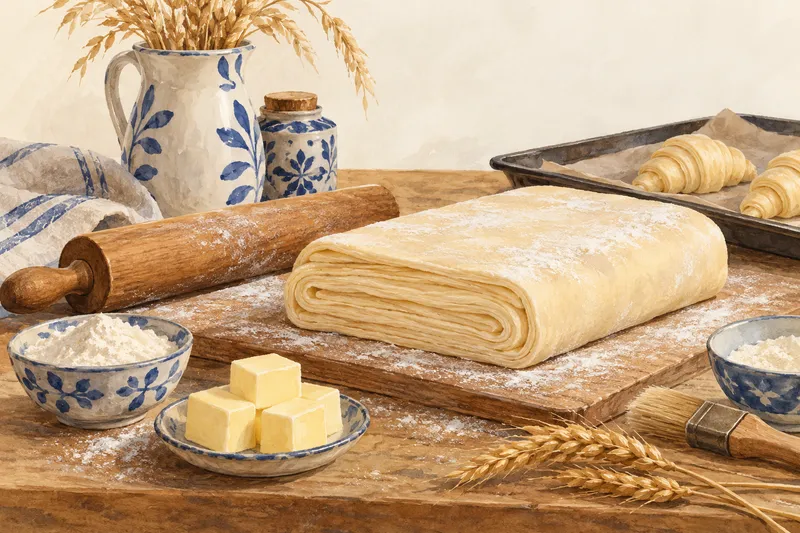
Lamination builds distinct layers
Classic puff pastry encloses butter in dough, then uses rolling and folding to build layers. King Arthur explains that steam helps expand those layers in the oven. Keeping the dough and butter workable is central to preserving them.
This is a technique overview, not a complete croissant or puff-pastry formula.
Compare the dough families
| Dough | Main distinction |
|---|---|
| Classic puff pastry | A butter block enclosed and folded into dough |
| Rough puff | Butter pieces incorporated before folding |
| Croissant dough | A yeasted dough with lamination and proofing stages |
| Phyllo | Separate paper-thin sheets layered during assembly |
Athens describes phyllo as very thin sheets used in preparations such as baklava and spanakopita. A stack of those sheets is not the same ingredient as a sheet of puff pastry.
Before you begin
Read the complete resting, chilling, folding, and shaping schedule. Prepare enough workspace and note the desired dimensions at each stage. Count completed folds on paper rather than relying on memory.
Observe the butter and dough together
Butter should bend with the dough rather than break into hard shards or smear out as grease. King Arthur’s lamination workbook, page 5, distinguishes two problems:
- Butter fractures while rolling: the butter and dough may have different pliability, or the butter may have become too cold between folds. Forcing the rolling pin harder does not restore a continuous butter layer.
- Butter leaks during baking: check whether the proofing environment was hot enough to melt the butter, then verify that the oven reached the recipe’s temperature. The workbook also identifies an oven that is too cool as a contributor.
Record the stage when leakage first appeared. This separates a proofing-temperature problem from one first visible in the oven; it does not prove that temperature is the only possible cause. Follow the original recipe’s resting and proofing sequence before changing its folds or butter quantity.
When using purchased pastry
Match the specified product and follow its thawing instructions. If changing between puff pastry and phyllo, choose an adaptation written for that change; assembly, fat application, thickness, and baking time may all differ. Keep any filling’s storage requirements with the finished pastry.
If the package says phyllo or filo
Phyllo and filo are names for the same thin-sheet family. They are not another name for puff pastry. Count and assemble sheets according to a complete phyllo recipe; there is no universal number of sheets that equals one puff-pastry sheet.
Athens’ handling guidance keeps unopened dough protected during thawing, then covers the opened stack with plastic wrap and a slightly damp towel while working. Prepare the filling and workspace before opening the sheets, remove only the sheets needed for the next step, and cover the rest promptly. That prevents a drying problem during assembly; it does not replace the package’s thawing schedule.
If you have phyllo and a puff-pastry recipe, choose a version designed for phyllo instead of preserving the original assembly and bake time. Follow product instructions for freezing or refreezing unused dough, and treat an assembled pastry’s filling as a separate storage decision.
Sources & scope
Reference synthesis and arithmetic where indicated. No first-hand kitchen testing is claimed.
- Classic puff pastryKing Arthur Baking · Accessed 2026-10-06
- Phyllo dough overviewAthens Foods · Accessed 2026-10-06
- Baker’s CroissantsKing Arthur Baking · Accessed 2026-10-06
- Introduction to laminated baking workbookKing Arthur Baking · Accessed 2026-10-06
- Phyllo Dough Foodservice FAQs: Storage, Thawing and HandlingAthens Foods · Accessed 2026-10-06