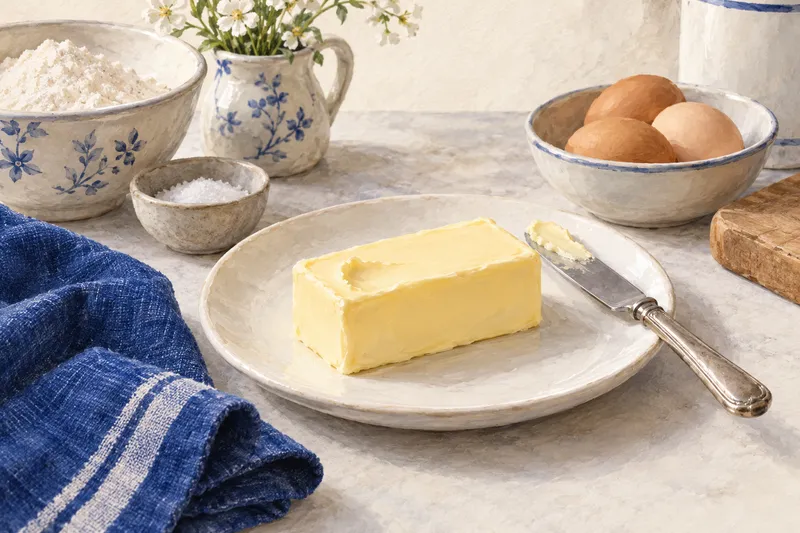
For a recipe that calls for softened butter, look for cool, pliable butter that still holds its shape. “Room temperature” describes the intended baking state; it does not mean any temperature your kitchen happens to reach.
Check the recipe before the butter
Read the ingredient line and the first mixing step together. Does the recipe ask you to cream butter with sugar, melt it, or add it cold? Those are different methods. King Arthur describes cookie recipes deliberately built around cold butter; softening their butter would change the method.
Use touch and appearance as checks
Sally’s Baking gives approximately 65°F (18°C) as its room-temperature-butter reference. It describes butter that feels cool and takes a finger indentation without looking greasy. Treat that temperature as an attributed guide, not a promise that every recipe needs exactly the same number. King Arthur’s pastry guidance describes a different softened range, around 68–72°F (20–22°C). This difference reinforces using the specific recipe’s method and the butter’s consistency.
Scroll the table sideways if needed.
| Observation | Next check |
|---|---|
| Hard, difficult to indent | If soft butter is requested, allow it to soften further. |
| Pliable, holds its outline, slight resistance | Compare with the recipe’s requested consistency. |
| Shiny, slumping, or partly liquid | Pause before creaming; this is beyond the intended softened state. |
King Arthur’s softening guide likewise emphasizes resistance to a finger press rather than a fixed waiting time.
Why the wording matters
Soft butter can hold air during creaming with sugar. Butter that is too firm or too soft changes that process. This does not mean every flat cookie is a butter problem: use the cookie troubleshooting guide to check quantities and method as well.
Plan for your kitchen
Check consistency while preparing the other ingredients. A warm kitchen, a cold block, and sliced butter will not all reach the same state on the same schedule. Use the softening guide when you need a practical method; no timer alone verifies the result.
Creaming butter is different from melting it
In a creaming recipe, beat butter and sugar together to the author’s described lightened texture, scraping the bowl as directed before the next ingredient. The step incorporates air; mixing sugar into melted butter follows a different method.
Begin with the specified butter consistency, then follow the recipe’s speed and endpoint. A pale appearance alone does not justify beating indefinitely, and a warm kitchen can soften the mixture while you work. If the butter becomes greasy or liquid, return to the consistency check before proceeding. Do not use the same minute count for a small hand-mixed batch and a large stand-mixer batch.
Sources & scope
Reference synthesis and arithmetic where indicated. No first-hand kitchen testing is claimed.
- Here’s What Room Temperature Butter Really MeansSally’s Baking · Accessed 2026-10-06
- Baking trials: How to soften butter quicklyKing Arthur Baking · Accessed 2026-10-10
- The hottest cookies are made with cold butterKing Arthur Baking · Accessed 2026-10-06
- Why does butter temperature matter in pastry?King Arthur Baking · Accessed 2026-10-06