Identify its job first
Cream of tartar can help stabilize whipped egg whites, or act as an acid alongside baking soda. Those uses need different replacement reasoning. It is neither dairy cream nor a complete baking powder.
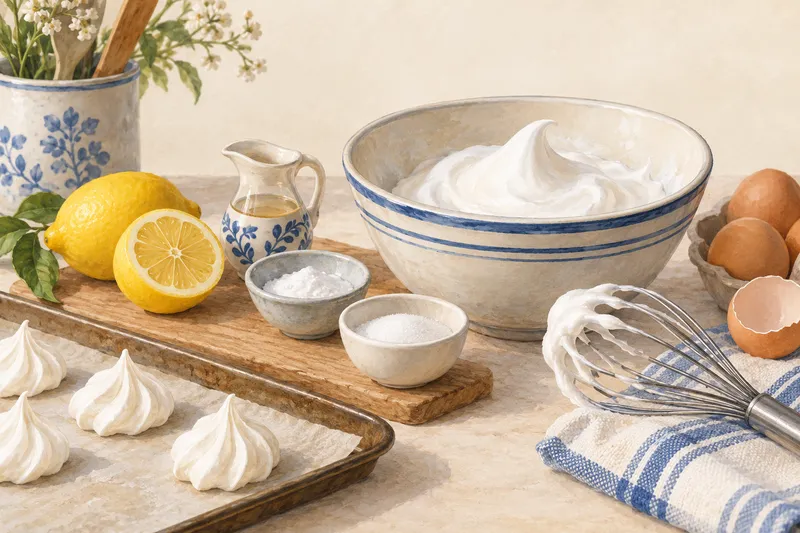
For whipped whites, King Arthur suggests small amounts of lemon juice or vinegar as possible alternatives, starting around ⅛ to ¼ teaspoon per white when the original calls for a pinch to ⅛ teaspoon cream of tartar. This is guidance for that foam-stabilizing use, not a general baking substitution ratio.
Meringue decision path
Use a clean bowl and follow the recipe’s whipping sequence. If the author provides an acid alternative, use it. Consider its flavor as well as its volume: more lemon juice is not automatically more stability. If no alternative is given for a technically demanding dessert, choose a recipe developed for the ingredients available.
In a dough with baking soda
Do not replace the cream of tartar with an arbitrary splash of acid while leaving every other quantity untouched. The acid balance, added liquid, and intended taste belong to the full formula. A snickerdoodle adaptation and a meringue substitution are not the same problem.
What to record
Note which role you are changing, the original amount, replacement amount, and stage of addition. If a foam collapses, review bowl cleanliness, whipping, mixing, and baking along with the acid choice. One failed result does not establish that the missing ingredient was the sole cause.
Is baking powder the same as cream of tartar?
No. Cream of tartar is an acid; baking powder is a leavening mixture containing an alkaline component and acid. Adding powder to stabilize egg whites introduces ingredients that the meringue method did not request. Keep the meringue replacement and the baking-powder replacement as separate decisions.
A three-white calculation
For a foam method that called for a pinch to ⅛ teaspoon cream of tartar per egg white, King Arthur’s starting alternative is ⅛–¼ teaspoon lemon juice or vinegar per white. With three whites, that arithmetic becomes ⅜–¾ teaspoon in total. Use the complete method and its stated stage of addition; the range is a starting alternative, not a stability guarantee.
Do not apply that calculation to cream of tartar paired with baking soda. For missing baking powder, use the separate soda-and-acid replacement instead.
Sources & scope
Reference synthesis and arithmetic where indicated. No first-hand kitchen testing is claimed.
- What is cream of tartar?King Arthur Baking · Accessed 2026-10-06
- Baking soda and baking powder substitutionsKing Arthur Baking · Accessed 2026-10-10