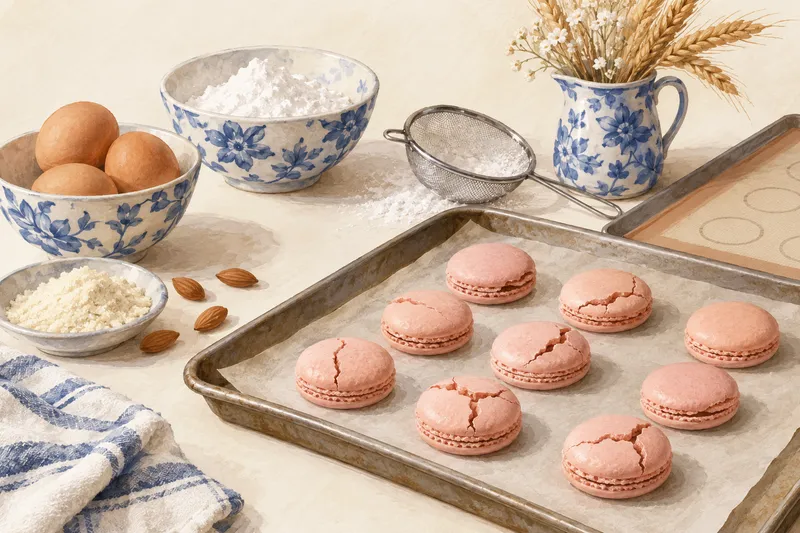
Identify the method before troubleshooting
French macarons begin with uncooked whipped whites; Swiss and Italian versions prepare their meringue differently. Keep the complete recipe and method together. A symptom such as a hollow shell can have several causes; its appearance cannot identify the mixing error by itself.
Check a French-method batch before it reaches the oven
Sally’s French macaron guide provides a useful sequence: a stiff, glossy meringue; controlled folding; a dry, non-tacky surface before baking; and shells that no longer wobble when gently checked near the endpoint. Its usual surface-drying estimate is 30–60 minutes, but the surface cue matters more than finishing a timer.
Scroll the table sideways if needed.
| Stage | Observable check | Decision |
|---|---|---|
| Meringue | Lifted peaks hold their points rather than drooping | Reach the recipe’s specified stage before adding the dry mixture |
| Folding | Batter flows continuously and settles into the surface | Check often; stop at the recipe’s flow cue rather than a fixed fold count |
| Piped shells | Surface is dry and no longer tacky | Recheck the surface if the recipe’s estimated rest has elapsed |
| Near the bake endpoint | Shell top is set rather than moving loosely on its foot | Use the recipe’s small additional bake interval if needed |
| Removal | Shells have completed the specified tray cooling | Do not judge hot sticking as proof of underbaking |
These checkpoints summarize a French recipe; they do not replace its ingredient quantities, temperatures, or full technique. A drying rest is not automatically transferable to every macaron formula.
What a ribbon check tells you
King Arthur’s macaronage explanation describes smoothing and deflating the mixed batter deliberately, then checking that it falls in a continuous ribbon and blends back into the surface. Folding is changing the batter’s aeration as well as combining ingredients. Once the batter is excessively fluid, more folding cannot restore the lost structure.
If one tray cracks while another succeeds, compare their drying time, tray position, oven reading, and portion size before deciding the entire meringue was faulty. If the batter spread excessively as soon as it was piped, investigate the pre-oven flow stage first.
Build a stage record instead of a defect guess
For the next batch, record the method, ingredient weights, meringue cue, a short video of batter flow, drying cue, oven reading, and bake time. Compare a completely cooled cross-section. Change the earliest recorded mismatch first. Our illustration is explanatory artwork; use the linked publisher’s actual process photographs and video for observed technique, not an AI image as evidence of a correct shell.
Your next-batch checklist
Use this while reviewing the recipe. Selections stay on this page only.
Sources & scope
Reference synthesis and arithmetic where indicated. No first-hand kitchen testing is claimed.
- French macarons guideSally’s Baking · Accessed 2026-10-06
- Mixing macaronsKing Arthur Baking · Accessed 2026-10-06