Use the recipe’s own weights first
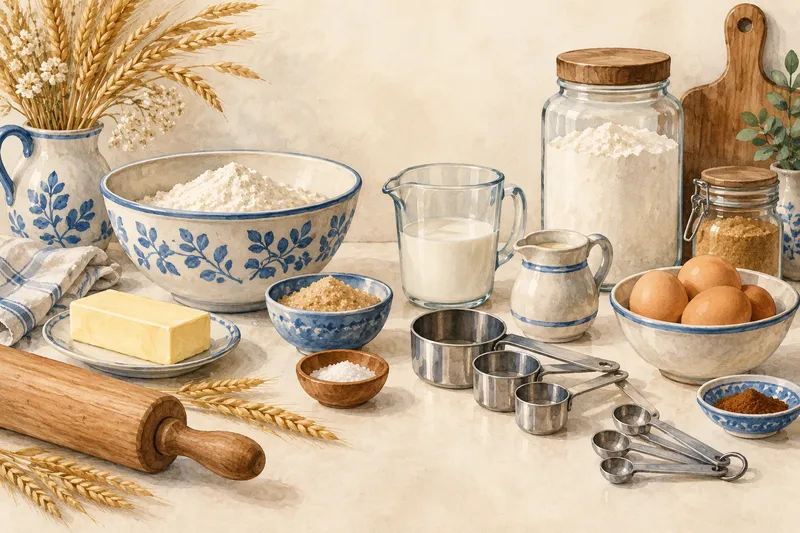
A cup is a volume; a gram is a mass. The ingredient and its preparation determine the relationship. Flour, butter, and packed brown sugar therefore cannot share one cups-to-grams number.
The ingredient table below uses the same named reference records as the site’s converter. If your recipe supplies its own gram weight, follow it. If it uses cups only, choose a convention deliberately and keep it consistent. The two flour references illustrate why a different source can give a different answer.
Arithmetic worth keeping nearby
- Cups to grams: cups × the selected grams per cup.
- Grams to cups: grams ÷ the selected grams per cup.
- Recipe scaling: target yield ÷ original yield, then multiply ingredient amounts.
- Baker’s percentage: ingredient weight ÷ total flour weight × 100.
- Celsius: (Fahrenheit − 32) × 5 ÷ 9.
- Fahrenheit: Celsius × 9 ÷ 5 + 32.
What a conversion does not decide
An ingredient multiplier does not multiply baking time. A temperature conversion does not automatically adjust for a fan oven. A pan-area comparison assumes comparable usable depth and does not establish a safe fill level.
Keep these decisions separate on your recipe notes: amount, equipment, oven setting, and doneness. That makes it easier to check an adaptation before mixing.
Print and use
Use your browser’s print command for this reference. The printable view keeps the guidance and source information. For unfamiliar amounts or fractions, open the calculators and retain the named ingredient standard with your result. Revisit the online version if a source convention changes rather than treating an old printout as a universal baking standard.
Choose the calculation for your task
Use the recipe scaler when ingredient weights are already known and you want a different yield. Use the dough formula calculator when a complete recipe gives baker’s percentages and you need weights or a target total.
For bakeware, start with inside pan measurements. The area converter compares bases for similar usable batter depth; the capacity calculator estimates a straight-sided pan’s full volume. Capacity and recipe fill are separate measurements.
Common amounts in grams
Scroll the table sideways to see every reference.
| Cups | All-purpose flour 120 g/cup · King Arthur Baking | All-purpose flour 125 g/cup · The Bake School | Butter 226 g/cup · King Arthur Baking | Granulated sugar 198 g/cup · King Arthur Baking | Brown sugar 213 g/cup · King Arthur Baking | Powdered sugar 113 g/cup · King Arthur Baking |
|---|---|---|---|---|---|---|
| ¼ | 30 g | 31.25 g | 56.5 g | 49.5 g | 53.25 g | 28.25 g |
| ½ | 60 g | 62.5 g | 113 g | 99 g | 106.5 g | 56.5 g |
| ¾ | 90 g | 93.75 g | 169.5 g | 148.5 g | 159.75 g | 84.75 g |
| 1 | 120 g | 125 g | 226 g | 198 g | 213 g | 113 g |
| 1½ | 180 g | 187.5 g | 339 g | 297 g | 319.5 g | 169.5 g |
| 2 | 240 g | 250 g | 452 g | 396 g | 426 g | 226 g |
| 3 | 360 g | 375 g | 678 g | 594 g | 639 g | 339 g |
All-purpose flour: Fluffed, spooned, and leveled · All-purpose flour: The Bake School reference · Butter: Solid butter · Granulated sugar: Granulated white sugar · Brown sugar: Packed; light or dark · Powdered sugar: Unsifted
Sources & scope
Reference synthesis and arithmetic where indicated. No first-hand kitchen testing is claimed.
- Ingredient Weight ChartKing Arthur Baking · Accessed 2026-10-10
- Baking conversionsThe Bake School · Accessed 2026-10-10