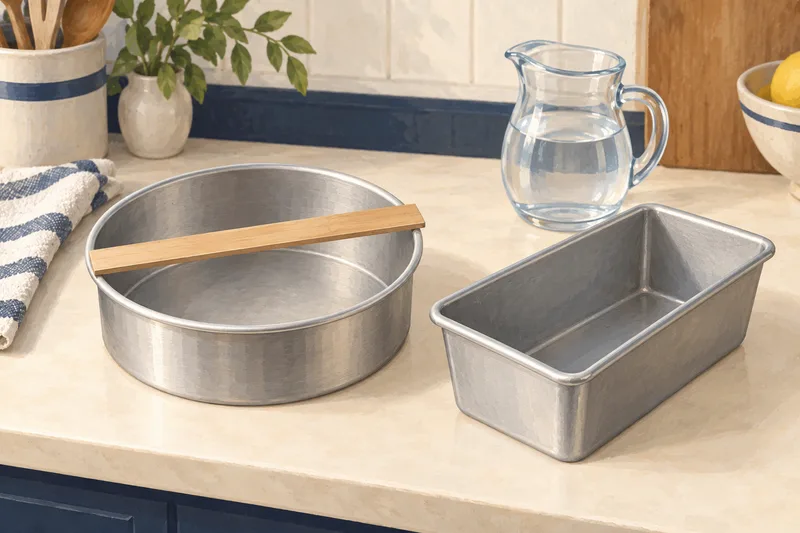
Measure an empty pan before changing a recipe. Its inside opening, vertical depth, and usable capacity answer different questions. A size name on the packaging may describe the outside footprint, which also matters for fitting the oven.
Measure the opening and depth
The Bake School measures the opening from inner edge to inner edge. For a round pan, measure across the center; for a rectangle, record inside length and width. Measure rectangle sides parallel to their edges, not diagonally corner to corner. Measure depth vertically from the inside base to the rim, rather than along a sloping wall.
Check the bottom dimensions too if the pan tapers. The pan converter uses simple area geometry and assumes comparable batter depth. It cannot account for a strongly tapered loaf pan or a shaped center tube.
Common names are starting points
Scroll the table sideways if needed.
| Pan description | Common dimensions | What to verify |
|---|---|---|
| Round cake pan | 8 or 9 inches across | Inside diameter and depth; different heights change capacity |
| Loaf pan | 8½ × 4½ or 9 × 5 inches | Exact recipe size, taper, and depth |
| Half-sheet pan | Often described as 13 × 18 inches | Outside fit, inside baking area, and rim height |
| Jelly-roll pan | Often 10 × 15 inches | Full dimensions in the recipe; the name is not a fixed capacity |
| Quarter-sheet pan | Nordic Ware example: 12.1 × 8.8 × 1.1 inches inside | This is a named product, not every quarter-sheet pan |
King Arthur’s pan guide distinguishes sandwich-loaf and quick-bread pans. A 9 × 5 label does not prove two pans have the same depth. Its common half-sheet example is 13 × 18 × ¾ inches. By comparison, Nordic Ware’s quarter-sheet listing lists interior dimensions of 12.1 × 8.8 × 1.1 inches for its named product. Check the outside footprint separately for oven fit. Use the manufacturer’s current specifications for the actual product.
Check capacity with water when shape matters
For a watertight pan, add measured water to determine full capacity, as Sally’s pan reference describes. Count the amount and record the measuring vessel’s convention. Sally’s reference gives an 8 × 2-inch round pan roughly six cups to the brim and a 9 × 2-inch round roughly eight cups. Those named reference capacities are not measurements of your particular pan. Sally’s chart uses a 240 mL cup; the capacity calculator uses the US liquid cup, approximately 236.59 mL. Keep the measuring vessel’s convention with the result instead of treating rounded chart capacities as exact geometry. A leaking springform pan is not suitable for this check without an appropriate watertight setup.
Brimful water capacity is not the amount of batter to bake. Leave the headroom required by the recipe. Equal full capacities also do not guarantee equal heating: a broad shallow pan and a narrow deep one can hold the same volume with different bake behavior.
A loaf-pan comparison you can calculate
For ideal straight-sided rectangles, 9 × 5 gives 45 square inches; 8½ × 4½ gives 38.25. The larger opening has about 17.6% more area. That explains why the same dough may sit lower, but it does not calculate its rise or baking time. Real taper further limits the estimate.
Choose the next step
Use the recipe’s specified pan when possible. If the author approves another size, follow that guidance. For a proposed change with similar depths, use the converter to estimate quantities and the recipe’s doneness checks to judge baking. Do not multiply minutes by the quantity factor.
What does a 2-quart pan mean?
A 2-US-liquid-quart capacity is 8 US cups, about 1.893 L, using NIST’s household capacity relationships. Capacity alone does not identify one pan length and width: different shapes and depths can hold the same volume. Also distinguish a full water capacity from the smaller batter quantity specified by a recipe.
For a straight-sided rectangular approximation, 8 × 8 × 2 inches = 128 cubic inches, about 8.87 US cups or 2.22 US quarts. A real tapered pan with rounded corners can hold less than this simple model. These numbers are arithmetic, not a claim about every pan labeled “8-inch square.”
Use the pan capacity calculator for a cylinder or rectangular-prism estimate. Verify a tapered, fluted, or shaped pan with measured water or the manufacturer’s stated capacity. Use the pan area converter for recipe-area comparisons; neither tool predicts a safe fill level or baking time.
Sources & scope
Reference synthesis and arithmetic where indicated. No first-hand kitchen testing is claimed.
- How to measure cake pan sizesThe Bake School · Accessed 2026-10-06
- Your complete guide to baking pansKing Arthur Baking · Accessed 2026-10-06
- Cake Pan Sizes & ConversionsSally’s Baking · Accessed 2026-10-06
- Naturals Baker’s Quarter SheetNordic Ware · Accessed 2026-10-06
- Metric HouseholdNIST · Accessed 2026-10-06
- How Do You Measure Fuel at the Gas Pump?NIST · Accessed 2026-10-06