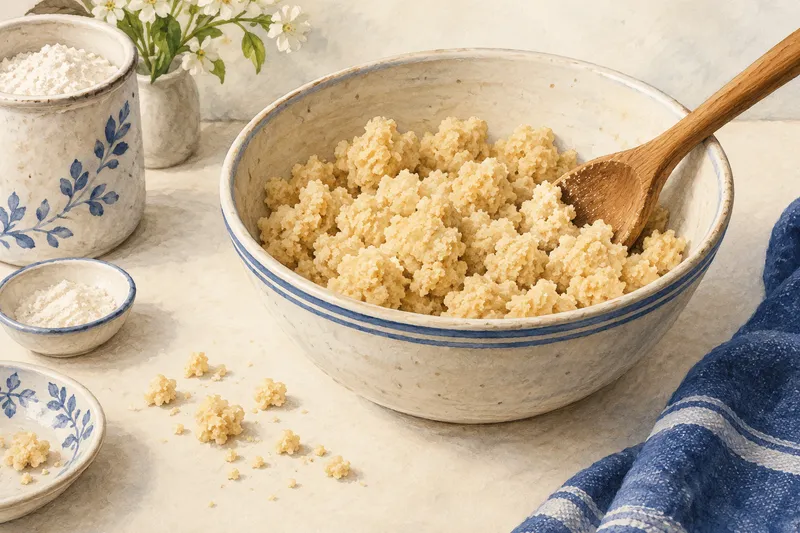
Check the stage of the recipe before treating crumbs as a failure. Dough that has not finished mixing, a sandy intermediate mixture, and finished dough that will not hold together are different situations.
Locate where you are in the method
Scroll the table sideways if needed.
| Stage | Question to answer | Next step |
|---|---|---|
| Before all wet ingredients are added | Does the recipe describe crumbs or coarse sand? | Continue the specified sequence before changing quantities. |
| Just after flour is added | Does the author say the dough takes time to come together? | Follow that mixing instruction and check its intended stopping point. |
| After chilling | Does the recipe give instructions for rolling or portioning? | Use those instructions rather than adding liquid to cold dough. |
| Finished mixing, still loose and dry | Were ingredients omitted, reduced, or mismeasured? | Audit the recipe and your recorded amounts. |
Crumbs can be part of the recipe
King Arthur’s shortbread recipe describes a mixture that initially seems dry and then forms a stiff dough with further mixing. Its cold-butter article also describes methods with a sandy stage before wet ingredients are added. Those examples explain why the mixing sequence matters; they do not justify endlessly beating every cookie dough.
Check quantities and substitutions
Compare flour, fat, eggs, and other liquids with the original recipe. Handle the Heat emphasizes accurate proportions and using the specified egg size in cookies. Record any ingredient substitution so you are not troubleshooting a changed formula as though it were the original.
If the flour was measured by volume, check the intended method. Use the flour measurement guide to understand the convention, not to retroactively assign an exact weight to an unknown cupful.
Why there is no universal liquid rescue
King Arthur’s shortbread recipe permits up to 1 tablespoon of water, if needed, after its specified mixing step. That instruction belongs to its complete shortbread formula and batch size. It is not an instruction to add a tablespoon to every crumbly drop-cookie dough.
For a dough already mixed, first establish whether you are at the intended endpoint and whether an ingredient was missed. Adding an arbitrary spoonful to a different formula changes its proportions without identifying the cause.
The useful next action is to identify the stage or departure you can verify. If none is clear, ask the original recipe author with the ingredient amounts and mixing sequence, rather than making several unrecorded changes.
Your next-batch checklist
Use this while reviewing the recipe. Selections stay on this page only.
Sources & scope
Reference synthesis and arithmetic where indicated. No first-hand kitchen testing is claimed.
- Shortbread CookiesKing Arthur Baking · Accessed 2026-10-10
- The hottest cookies are made with cold butterKing Arthur Baking · Accessed 2026-10-06
- Ultimate Cookie Troubleshooting GuideHandle the Heat · Accessed 2026-10-10