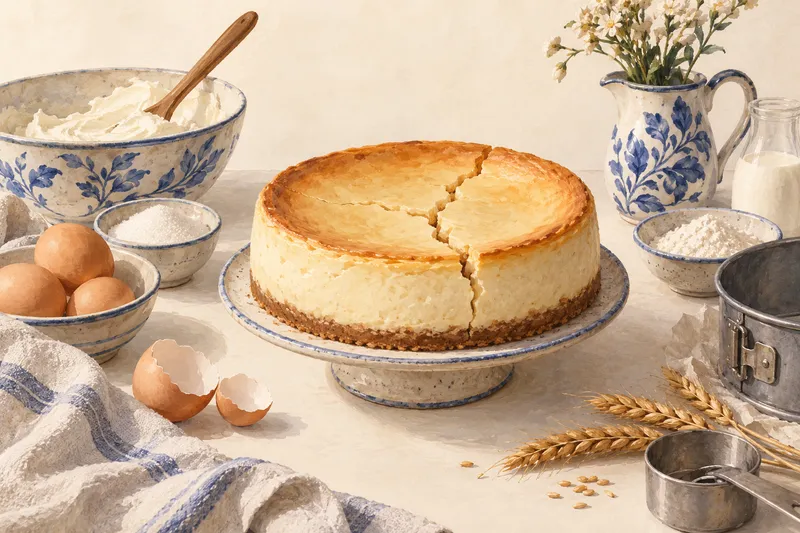
A crack is a clue, not a complete diagnosis
King Arthur identifies overbaking, excessive mixing, and sudden temperature change as common contributors to cracked cheesecake. Note when the crack appeared: during baking, while cooling, or after chilling. That observation is more useful than the crack’s shape alone.
Review three stages
Mixing: did the recipe call for gentle incorporation, and were ingredients in the specified condition? A high-speed beating step borrowed from a sponge cake can introduce unwanted air.
Baking: did you keep going until the center was completely rigid? Compare the actual endpoint with the original recipe, including any thermometer location and water-bath instructions.
Cooling: did the cake experience an abrupt change instead of the prescribed sequence? Plan the cooling space before baking so the method can be completed safely.
Check changes to the setup
Different pan size, filling depth, or oven setting can alter the result. Keep those variables with your notes instead of assuming a crack proves the water bath failed. Never extend a cooling method indefinitely just to avoid a cosmetic defect; safe refrigeration remains necessary.
What can be fixed after baking
If the cheesecake is properly baked and handled, an appropriate topping can conceal a cosmetic crack. It cannot correct an underbaked filling or unsafe storage. Chill and serve according to the recipe.
For the next batch, choose one correction supported by the record. Avoid simultaneously changing oven temperature, mixing time, ingredient ratios, and pan size, which makes the next outcome difficult to interpret.
Your next-batch checklist
Use this while reviewing the recipe. Selections stay on this page only.
Sources & scope
Reference synthesis and arithmetic where indicated. No first-hand kitchen testing is claimed.
- Why did my cheesecake crack?King Arthur Baking · Accessed 2026-10-06