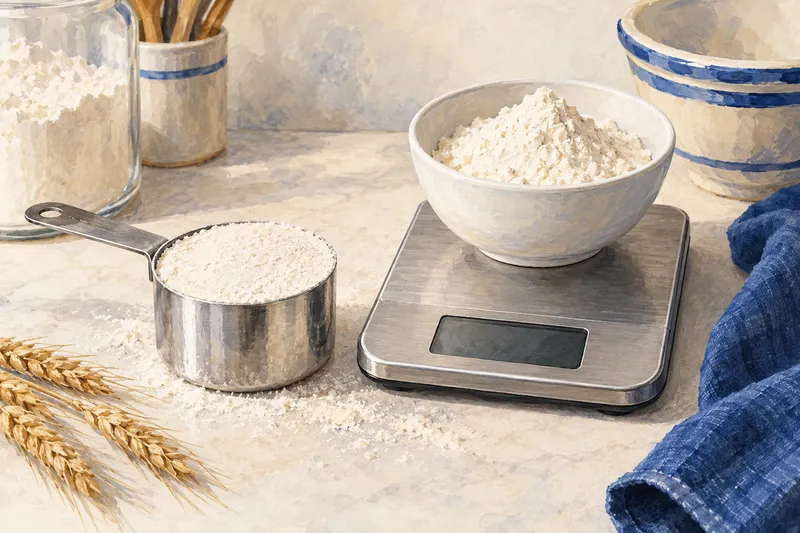
A cup of all-purpose flour does not have one universal gram weight. King Arthur Baking uses 120 g per cup; The Bake School uses 125 g. If your recipe gives grams, use those grams. If it only gives cups, follow its author’s measuring method or stated conversion.
Compare common quantities
These are arithmetic conversions from two published reference weights. They are not results from our own kitchen testing.
The live reference table below is generated from the same weight records as the converter.
Why the reference matters
The two conventions differ by 5 g for each cup. At three cups, that becomes 15 g. This is a reason to preserve the recipe author’s convention when scaling, rather than substituting a different chart midway through a recipe.
Packing, scooping, and leveling affect how much flour goes into a cup. A scale helps you reproduce a specified mass; it cannot tell you which mass a cup-only recipe intended.
A practical order to follow
- Use gram weights supplied in the recipe.
- If there are none, look for the author’s conversion chart or measuring instructions.
- If neither exists, choose a stated reference and record it for your next bake. Treat the result as an estimate, not a guaranteed match.
What this converter covers
The flour entries here are for all-purpose flour. They are not interchangeable with almond flour, whole-wheat flour, or sifted-volume measurements. The cup follows the selected source’s recipe convention; this tool does not silently convert a 250 mL metric cup into a US recipe cup.
For cups to grams, multiply the cup amount by the selected grams per cup. For grams to cups, divide. Displayed answers are rounded to two decimal places; the extra digits describe the calculation, not kitchen-scale accuracy.
A worked conversion and a custom reference
For 1½ cups, the arithmetic is 1.5 × 120 = 180 g under King Arthur’s convention, or 1.5 × 125 = 187.5 g under The Bake School’s. Select the named reference in the ingredient converter; neither answer overrides a recipe that already supplies grams.
If a particular recipe states 2 cups = 260 g, its implied one-cup reference is 260 ÷ 2 = 130 g. Enter 130, not 260, as the converter’s custom grams-per-cup value. This example shows how to preserve a recipe’s convention; it is not another measured flour standard.
Common amounts in grams
Scroll the table sideways to see every reference.
| Cups | All-purpose flour 120 g/cup · King Arthur Baking | All-purpose flour 125 g/cup · The Bake School |
|---|---|---|
| ¼ | 30 g | 31.25 g |
| ½ | 60 g | 62.5 g |
| ¾ | 90 g | 93.75 g |
| 1 | 120 g | 125 g |
| 1½ | 180 g | 187.5 g |
| 2 | 240 g | 250 g |
| 3 | 360 g | 375 g |
All-purpose flour: Fluffed, spooned, and leveled · All-purpose flour: The Bake School reference
Convert your amount
Ingredient converter
Cups ↔ grams
Use the recipe author's gram weight when available. Reference: King Arthur Baking.
Sources & scope
Reference synthesis and arithmetic where indicated. No first-hand kitchen testing is claimed.
- Ingredient Weight ChartKing Arthur Baking · Accessed 2026-10-10
- Baking conversionsThe Bake School · Accessed 2026-10-10
- How to measure flour the right wayKing Arthur Baking · Accessed 2026-10-10