Look for a set edge and a smaller moving center
A pumpkin custard pie does not need to be rigid throughout when it leaves the oven. King Arthur describes a set outer area and a center that moves like gelatin rather than loose liquid. Residual heat continues the process after removal.
For its standard 9-inch pie discussion, King Arthur gives a center range of 160–170°F as an additional cue. Use your own recipe’s instructions and measurement location; that example is not a universal endpoint for every pie size or filling.
Avoid two opposite mistakes
A filling that remains liquid across most of the surface needs more than a hopeful chill. At the other extreme, baking until the entire surface is firmly set can produce an overcooked texture or cracks.
Use the written bake time to prompt inspection, then assess the relevant cues together. A browned crust does not prove the custard beneath it has reached the intended state.
Check the setup
Confirm the pan size and depth, filling quantity, oven temperature unit, and whether the recipe uses an initial hotter stage. A change to one of these can make the printed timing less useful.
Plan cooling and storage before baking
Read the pumpkin-pie storage guide and the recipe’s cooling sequence. Refrigeration is part of safe handling for a traditional homemade pumpkin pie; it is not a way to cook raw filling.
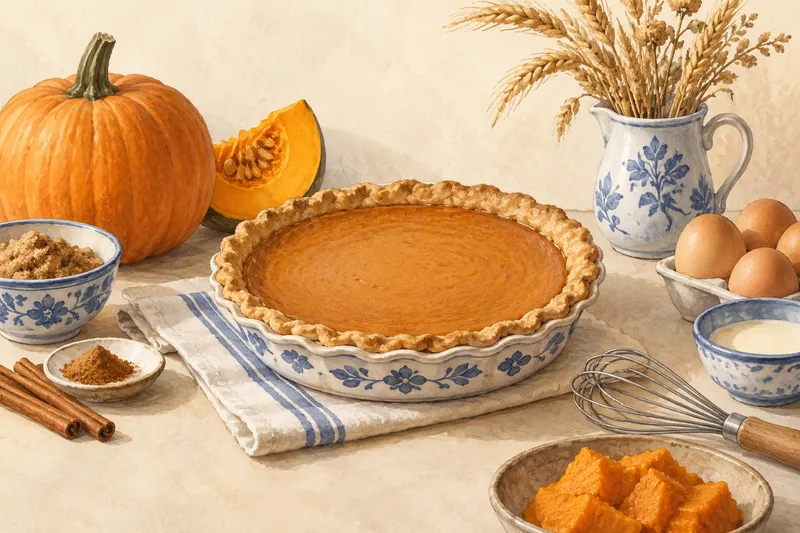
Use the source’s actual demonstration if learning the movement cue. The generated illustration on this page is not a doneness test or a record of a pie baked in our kitchen.
Sources & scope
Reference synthesis and arithmetic where indicated. No first-hand kitchen testing is claimed.
- How to tell when pumpkin pie is doneKing Arthur Baking · Accessed 2026-10-06