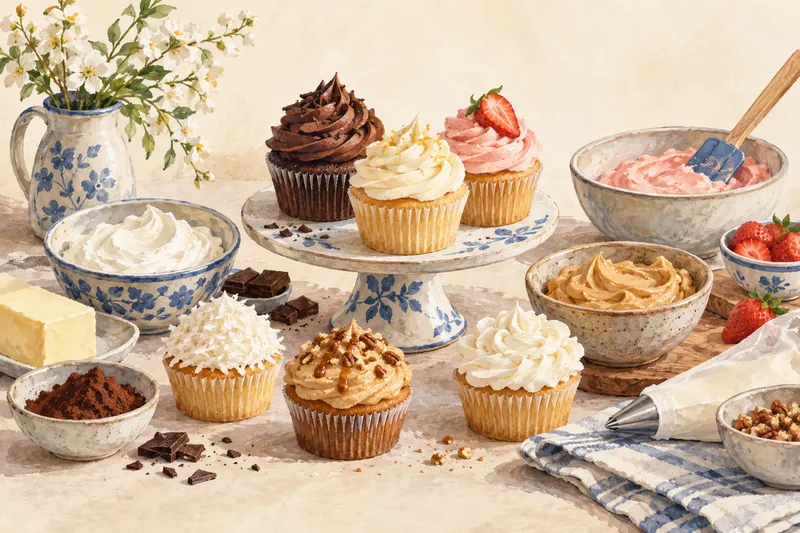
Choose the job before choosing a frosting
A soft cake filling, a piped border, a firm cookie decoration, and a pourable glaze need different textures. Select a complete recipe for the job and plan storage for the entire dessert, including any filling beneath the frosting.
Compare the preparation and likely use
The following families follow King Arthur’s frosting overview. The use column helps narrow a choice; the exact recipe determines firmness and piping detail.
Scroll the table sideways if needed.
| Style | Main preparation | Job to consider |
|---|---|---|
| American buttercream | Butter with confectioners’ sugar | Straightforward cake coating and piping |
| Swiss buttercream | Heated whites and sugar, whipped; butter added | Smooth cake coating and piping |
| Italian buttercream | Hot syrup into whipped whites, then butter | Smooth coating; more involved syrup workflow |
| French buttercream | Yolk or whole-egg syrup base with butter | Rich cake filling or coating |
| German buttercream | Pastry cream with butter | Custard-flavored filling or coating |
| Ermine | Cooked flour-and-milk base, cooled; butter added | Soft cake coating with a cooked-base method |
| Cream cheese frosting | Cream cheese, fat and sugar | Tangy coating; piping depends on formula |
| Royal icing | Egg-white or meringue-powder icing | Cookie decoration that dries firm |
| Ganache | Chocolate and liquid | Glaze, spread or filling according to ratio |
These descriptions omit critical cooking and mixing details. A syrup or heated-egg method needs its complete temperature and handling instructions. Royal icing is not a soft layer-cake filling, and a pouring ganache cannot be assumed to hold a piped flower.
Named storage examples make planning clearer
Sally’s Vanilla Buttercream can be tightly covered in the refrigerator for up to 1 week, or frozen for up to 3 months, according to that recipe. It is thawed in the refrigerator and beaten again to restore consistency. Those are instructions for the named American-style frosting, not every buttercream.
Sally’s Cream Cheese Frosting stores leftover frosting refrigerated for up to 5 days or frozen for up to 3 months. Those frosting limits do not establish the life of every finished cake. If the cake also contains a perishable filling, the filling’s requirements remain in force even under another frosting.
Shape stability is a separate question
“Holds its shape” describes appearance, not safety in a hot room. FDA perishable-food limits: refrigeration 40°F or below; exposure no more than 2 hours, or 1 hour above 90°F, for foods requiring refrigeration, including assembly and service.
Before committing to an event design, check the complete recipe’s yield, coating thickness, refrigeration needs, and serving conditions. For a split or gritty frosting, identify its family before using the buttercream troubleshooting guides; a texture repair does not reset the storage clock.
Choose frosting by method and storage
For a frosting without confectioners’ sugar, look at a complete cooked-sugar or cooked-base recipe, such as the Swiss, Italian, or ermine families above. Do not remove powdered sugar from an American buttercream and expect its thickness to remain.
If an existing frosting is loose, identify its family before adding anything. Warm meringue buttercream may need temperature correction; a glaze intended to pour may already be correct. Use the split-buttercream checks for the former. A frosting intended to pour needs its own recipe endpoint; adding powdered sugar changes that formula.
For make-ahead planning, the named storage examples apply to those recipes. A cake’s perishable filling can require refrigeration even when another component tolerates a different setting. Check the shortest applicable handling limit and allow time for any instructed thawing and rebeating.
Does cream cheese frosting need refrigeration?
For conventional homemade cream cheese frosting, yes: refrigerate the frosting and the frosted cake. Iowa State Extension explains that sweetness alone does not establish shelf stability. Its laboratory-tested buttercream is a specific formulation; changing ingredients can change the result. Do not treat a high sugar content, a stiff piped finish, or someone else’s recipe as proof that your cream cheese frosting can stay out overnight.
Use the perishable-food limits above when planning assembly, transport, and service. For example, 30 minutes decorating + 45 minutes transporting without temperature control + 45 minutes on the table = 2 hours. Putting it back in the refrigerator does not erase that exposure. That schedule already uses the full room-temperature allowance; shorten service or maintain refrigeration instead of planning right up to the limit. Keep the cake at 40°F or below during temperature-controlled transport, and use the one-hour limit when the environment exceeds 90°F.
Discard conventional cream-cheese frosting or cake left out overnight rather than tasting it or chilling it as a rescue. For a commercial product, follow its own storage label; a shelf-stable unopened tub does not establish the handling requirements of a homemade mixture.
Sources & scope
Reference synthesis and arithmetic where indicated. No first-hand kitchen testing is claimed.
- A breakdown of cake frostingsKing Arthur Baking · Accessed 2026-10-06
- Ermine frostingKing Arthur Baking · Accessed 2026-10-06
- Water ganacheKing Arthur Baking · Accessed 2026-10-06
- Favorite Vanilla ButtercreamSally’s Baking · Accessed 2026-10-06
- Cream cheese frostingSally’s Baking · Accessed 2026-10-06
- Are you storing food safely?FDA · Accessed 2026-10-06
- Safe Frosting for Iowa 4-H FairsIowa State University Extension and Outreach · Accessed 2026-10-06