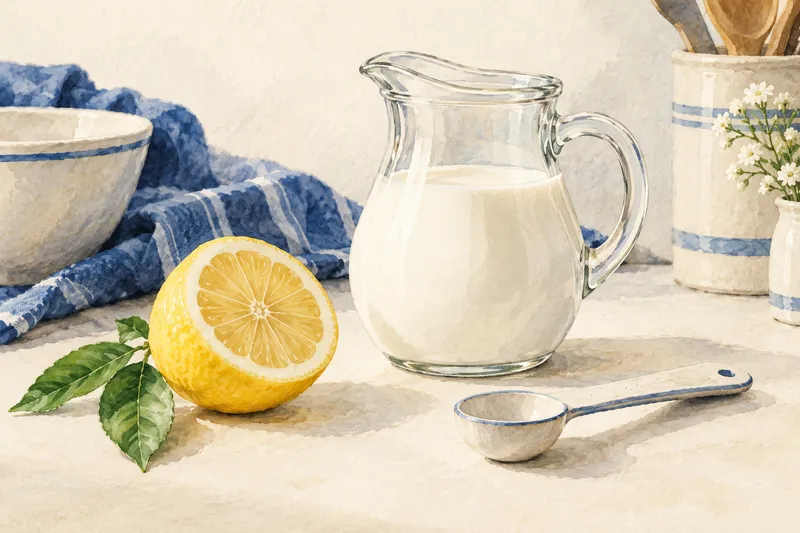
Acidified milk is a baking replacement, not cultured buttermilk. It can provide acidity, but it does not reproduce every property of the original ingredient. Start with any replacement notes in your recipe.
One documented method
Sally’s Baking uses 2 teaspoons of white vinegar or lemon juice, then whole milk added to reach 1 cup total, followed by a five-minute rest. Put the acid in the measuring vessel first so it is included in the final volume.
Scroll the table sideways if needed.
| Final amount needed | Acid | Whole milk |
|---|---|---|
| ¼ cup | ½ teaspoon | Add to the ¼-cup line |
| ½ cup | 1 teaspoon | Add to the ½-cup line |
| 1 cup | 2 teaspoons | Add to the 1-cup line |
The smaller amounts are proportional calculations from that method. They are not independent baking trials.
What this method cannot promise
Sally’s comparison found differences among recipes and favors real buttermilk when it is a major ingredient. A bread relying heavily on buttermilk is a different decision from a small amount in another batter. The source’s comparisons belong to its tested recipes; this site has not repeated them.
King Arthur publishes a different acidified-milk proportion and also discusses yogurt, sour cream, and kefir options. This variation is why the method above is named rather than presented as a universal standard. Follow one documented method consistently.
Make the decision before mixing
Scroll the table sideways if needed.
| Your situation | Useful next step |
|---|---|
| Recipe author supplies a replacement | Follow that recipe-specific guidance. |
| Small amount needed; whole milk and acid available | Consider the named method and its limits. |
| Buttermilk is central to the formula | Use real buttermilk or a recipe developed for what you have. |
| You need dairy-free or other dietary adaptation | Use a specifically developed recipe; this dairy method does not establish equivalence. |
Do not remove baking soda or change baking powder at the same time without recipe-specific guidance. That would introduce another formula change and make the result harder to interpret.
Why the final volume matters
For the ½-cup row, put the measured 1 teaspoon of acid in the liquid measure, then pour whole milk only to the ½-cup mark. A full half-cup of milk plus the acid gives more than the specified final amount.
This table scales volume within Sally’s named method. The gram-based recipe scaler cannot choose an acid dose or infer a milk density for it. Complete this ingredient decision before scaling the rest of your recipe.
Sources & scope
Reference synthesis and arithmetic where indicated. No first-hand kitchen testing is claimed.
- Buttermilk Substitute (& Recipes)Sally’s Baking · Accessed 2026-10-06
- Buttermilk substitute: What to useKing Arthur Baking · Accessed 2026-10-06