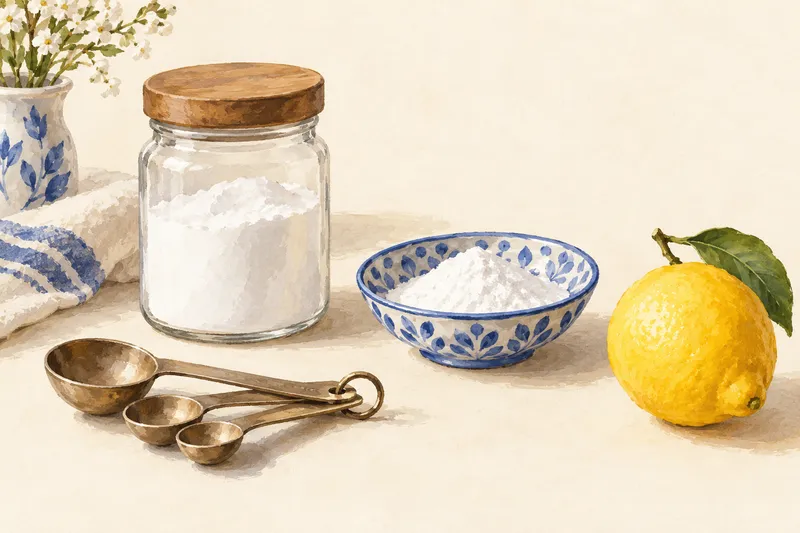
Can baking powder replace baking soda?
Sometimes, but it is not an equal-amount swap. Baking soda is alkaline; baking powder already contains an acid component. Changing one changes more than the amount of lift.
King Arthur gives three teaspoons of baking powder for one teaspoon of baking soda as an emergency starting point. That does not remove the acid already in the recipe or guarantee the intended browning and flavor. For a recipe with several interacting leaveners, use the author’s substitution instructions.
Check the recipe before measuring
- Highlight the soda amount and every acidic ingredient, including cultured dairy or natural cocoa.
- Check whether baking powder is already present. Do not replace the soda and accidentally double the powder listed separately.
- Identify the bake: an intentionally browned cookie and a delicate cake do not have identical requirements.
- Confirm you have food-grade baking powder, not another white powder from the pantry.
When to choose another recipe
For a special-occasion bake, a very small batch with difficult fractional spoon measurements, or a recipe already changed for other missing ingredients, choose a formula written for the leavener you have. Stacking substitutions makes a disappointing result harder to diagnose.
Do not add extra acid merely because you changed the soda to powder: the original recipe may already contain plenty. If you are replacing powder with soda instead, read the separate baking-powder guide; reversing a ratio does not reverse all the chemistry.
Record the change
Write the original and replacement amounts beside the recipe before mixing. Keep the original oven setting and use that recipe’s doneness guidance. This page describes a fallback, not a tested adaptation of your recipe.
Can I skip baking soda in a recipe?
Not without changing how the recipe behaves. Soda may balance an acidic ingredient as well as provide lift. A recipe containing both soda and powder does not necessarily have a redundant ingredient: the powder supplies additional leavening while the soda has its own role. Use a documented adaptation rather than deleting one.
Keep powder already in the recipe separate
For an arithmetic example, suppose a recipe lists 1 teaspoon powder plus ½ teaspoon soda. Applying the cited fallback only to the soda contributes another 1½ teaspoons powder, giving 2½ teaspoons powder total. The pre-existing teaspoon is included once.
This example prevents a counting mistake; it does not establish that the adapted recipe will work. King Arthur warns that the larger powder quantity can produce a bitter taste, and the original acid balance still matters. For an important bake, choose a complete formula written for the leavener available.
Sources & scope
Reference synthesis and arithmetic where indicated. No first-hand kitchen testing is claimed.
- Baking soda and baking powder substitutionsKing Arthur Baking · Accessed 2026-10-10
- Baking Soda vs. Baking PowderArm & Hammer · Accessed 2026-10-06