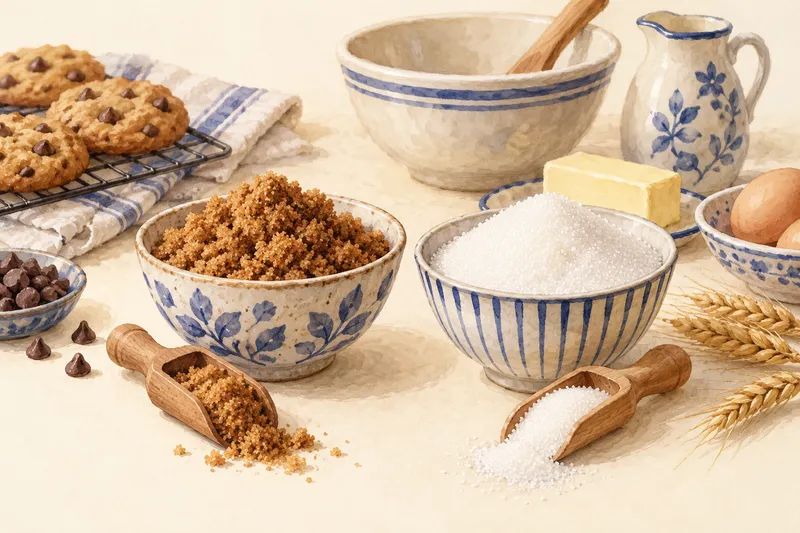
The difference goes beyond color
Brown sugar contains molasses, which changes flavor and acidity. Granulated white sugar does not bring the same molasses character. In cookies, the effect of changing the sugar balance depends on the rest of the formula; a universal promise of more or less spread is misleading.
Compare what you actually measure
A cup of packed brown sugar is not the same preparation as a cup of loose granulated sugar. Use the recipe’s gram weights when provided. If you need to convert a cup amount, select the correct sugar and preparation in the ingredient converter rather than borrowing flour’s weight.
A practical recipe note should list the two sugars separately: original brown-sugar amount, original white-sugar amount, and exactly what changed. ‘Used less sugar’ is not enough to repeat the result.
Choose the right next step
- Out of brown sugar: consult the brown-sugar substitution guide and check whether you have molasses.
- Want less sweetness: look for a recipe developed with less sugar; removing sugar can alter more than taste.
- Want a different cookie texture: start with a recipe describing the texture you want, then compare its method and ingredients.
- Only have dark instead of light brown sugar: expect a different molasses emphasis and check the recipe’s own note.
Avoid judging from an illustration
A darker cookie may reflect sugar choice, cocoa, baking time, oven behavior, or several changes together. An illustration cannot isolate the cause. For an informative home comparison, keep portion weight, pan, oven setting, and cooling time consistent and record the one ingredient change.
Use the original formula for important occasions until an adaptation has worked in your own kitchen.
Does a cup-for-cup swap preserve the weight?
Not under every chart. King Arthur’s reference lists 198 g for a cup of granulated sugar and 213 g for a packed cup of brown sugar. A half cup corresponds to 99 g and 106.5 g respectively. The 15 g difference per cup is arithmetic from those entries; the recipe may provide different weights.
This explains why “replace one cup” and “replace 198 g” are different instructions. Neither establishes identical cookie texture. For missing brown sugar, use the documented sugar-and-molasses option. For hard sugar, use the storage and softening guide.
Sources & scope
Reference synthesis and arithmetic where indicated. No first-hand kitchen testing is claimed.
- Make your best cookies with these 10 tipsKing Arthur Baking · Accessed 2026-10-06
- A guide to different types of sugars, how to use them, and when to substituteKing Arthur Baking · Accessed 2026-10-10
- Ingredient Weight ChartKing Arthur Baking · Accessed 2026-10-10