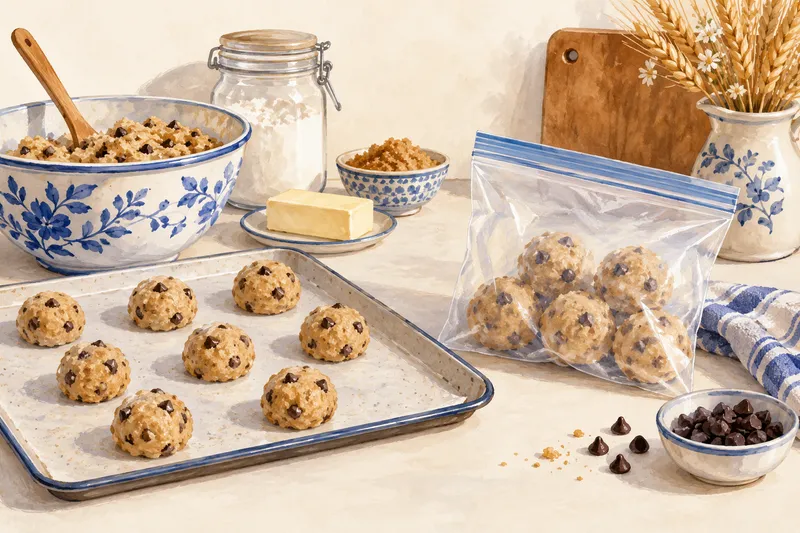
Match the package to the cookie
Drop-cookie portions, cut-out dough discs, and slice-and-bake logs need different preparation. Sally’s freezing guide distinguishes these forms rather than treating every bowl of dough the same. Delicate meringue-based mixtures need their own recipe instructions; they are not ordinary make-ahead drop dough.
A practical packing plan
- Drop cookies: complete the recipe’s required chill, portion consistently, and package once the portions can retain their shape.
- Cut-out cookies: package manageable discs so later rolling does not require thawing an unnecessarily large mass.
- Slice-and-bake cookies: preserve the log shape and use the recipe’s thawing guidance before cutting.
- Sugar-coated cookies: check whether the coating belongs on before freezing or just before baking.
Use freezer-suitable packaging and identify the recipe and date. Include the original portion size and bake setting so the package remains useful months after you made it.
Baking from frozen is recipe-specific
Some drop cookies can go into a preheated oven from frozen; other shapes need a refrigerator thaw before rolling or slicing. Follow the particular recipe instead of applying a universal extra-minute rule. Freezing does not cancel an earlier dough-resting step that the recipe requires.
Keep one clear record
Write whether the portions were frozen before or after coating, whether they require thawing, and how many are in the package. Keep the source recipe accessible rather than putting only a temperature on the label.
If you have already changed the formula, treat freezing as an additional untested change. A small planned batch gives you a more informative comparison than freezing the entire bowl without notes.
A named freezing schedule for drop and cut-out dough
Sally’s dough-freezing guide uses up to three months for its described doughs. For drop cookies, complete the recipe’s initial chill, portion, then cover and refrigerate the shaped pieces for an hour before packing. Its frozen portions bake at the recipe temperature with roughly one or two additional minutes; check the cookie’s endpoint rather than transferring that estimate to a much larger portion.
For cut-out dough, the guide freezes wrapped discs, then thaws them in the refrigerator overnight before rolling and cutting. Slice-and-bake logs similarly need enough refrigerator thawing to slice cleanly. Those steps explain why “bake from frozen” cannot be one instruction for every cookie shape.
Record shape, coating stage, date, portion size, recipe temperature, and whether thawing is required on the package. Freezing preserves a prepared dough; it does not make raw dough safe to taste or repair unsafe handling.
How long can cookie dough stay in the refrigerator?
Use the complete recipe’s make-ahead window, rather than assuming that every dough lasts a week. As a concrete example, Sally’s Chewy Chocolate Chip Cookies specifies covered refrigeration for at least 2–3 hours and up to 3 days. The first number is a required dough rest; the second is that recipe’s make-ahead limit. One does not replace the other.
If you intend to bake later than the named refrigerator window, follow a supported freezing plan while the dough is still appropriately handled. Record the mixing date as well as the freeze date. Commercial refrigerated dough follows its package’s use-by and after-opening instructions, not this homemade example.
A pleasant smell, a fresh-looking surface, or an egg-free formula does not establish that an unknown batch is safe. Raw flour remains a reason not to taste unbaked dough; freezing is not a cooking step.
Keep the cold-storage conditions in the plan
FDA storage guidance calls for a refrigerator at 40°F or below and a freezer at 0°F. Check the appliance temperature, package the dough promptly under its recipe instructions, and label its mixing and freezing dates separately.
The named three-day refrigerator window and three-month freezing schedule describe their cited recipes. Neither means an unknown batch becomes safe when its package is re-dated or moved to the freezer. Keep the required chill and the intended portion size in the same record.
Sources & scope
Reference synthesis and arithmetic where indicated. No first-hand kitchen testing is claimed.
- How to freeze cookie doughSally’s Baking · Accessed 2026-10-06
- Can you make cookie dough ahead of time?King Arthur Baking · Accessed 2026-10-06
- Food safety by type of foodFoodSafety.gov · Accessed 2026-10-06
- Chewy Chocolate Chip CookiesSally’s Baking · Accessed 2026-10-06
- Are you storing food safely?FDA · Accessed 2026-10-06